Case study
LinkyStat
Data pipeline · Time-series · Long-term
GitHubCapture, store and visualise electricity consumption from the Linky meter.
A Linky meter, 'connected'. You've got my attention. Connected how, exactly?
The Enedis TIC spec, fine. A little USB key from hallard.me to read the serial frame, and now I'm on home ground: software.
I can read the telemetry (TIC). One raw frame, one checksum to validate. I've got my first data.
Drop it all into a database, Grafana on top, and let it accumulate. Not a real-time gadget: long memory, usable over years.
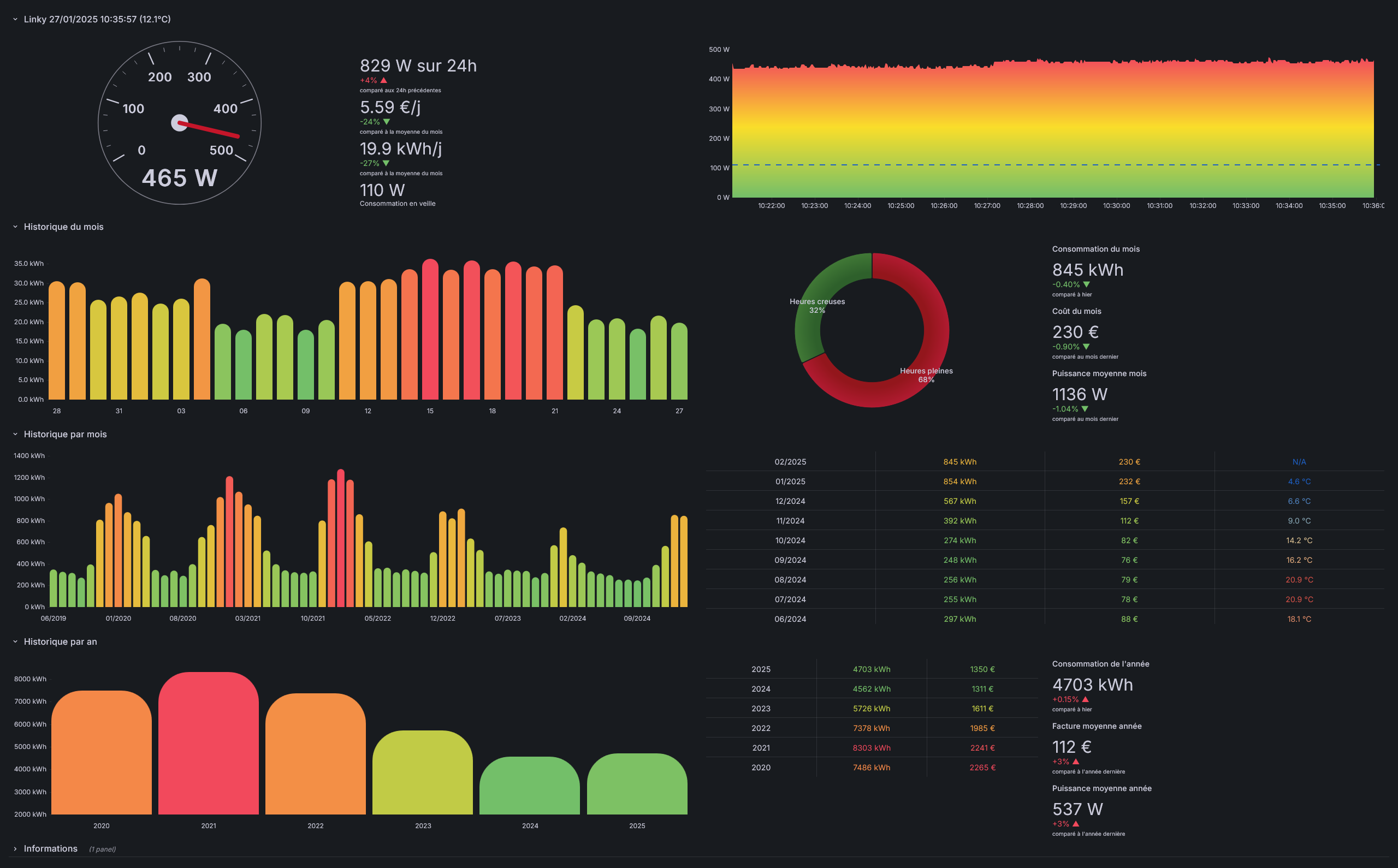
Plain Python script into MySQL/Grafana. A simple relational schema: no cardinality explosion, no complex retention policy (full real-time for 2 days, hourly history for 7 years), queries still readable years later.
7 years of data in a single 1 MB dump. Simple, fast backup and restore, automated via GitHub Actions.
Continuous production since day one. CI/CD via GitHub Actions. Unbroken history: simplicity and lightness delivered excellent reliability.
A Grafana view that answers the questions I started with: short, medium and long-term views, trends. Value compounded over time.
After the first years of observation at close to 8,000 kWh/year, I targeted electric heating first: better use of per-room daily schedules, optimising time slots.
Consumption dropped to 6,000 kWh/year.
The standby audit: 'I switch everything off at home and watch what's left drawing power'.
I identified close to 300 W of permanent standby, around 2,500 kWh/year.
I brought that down to 120 W, around 1,000 kWh/year.
Consumption dropped to ~4,500 kWh/year.
'How much would my consumption cost at a different supplier?'
No API from suppliers: rate tables come as PDFs, updated often and without notice.
I tried to download and parse those PDFs automatically. The tables were too irregular: parsing broke on every rate revision. Too much recurring work.
I ended up hard-coding prices. Simple and robust, but wrong the moment a rate moves. A conscious trade-off: I'd rather have accurate kWh than a fake cost.
I could see total consumption falling. But what was actually using power, appliance by appliance? Impossible to know from a single meter.
A few smart plugs, a TIC interface on the Linky, and Home Assistant made LinkyStat obsolete: once per-appliance power sensors are in place, Home Assistant aggregates everything natively, long-term history included. No need to collect frames, parse them, store them in a database and visualise in Grafana. Home Assistant does all of that, better, with an active community and a rich ecosystem.
Nothing was lost: 7 years of LinkyStat data were migrated and are visible in the Home Assistant energy dashboard without any gap. The LinkyStat code stays on GitHub. The Grafana/MySQL instance is gone: no point running a separate stack when another does the same job better.
Move to Home Assistant →References
-
[01]
Teleinfo Client (TIC) Specification, Enedis
The official spec for the serial protocol emitted by the Linky meter: frames, fields, checksums. Without it, the signal is undecipherable.
-
[02]
hallard.me, Charles-Henri Hallard
The maker behind the PiTInfo / LibTeleinfo USB key. Where I bought the hardware and found the community that actually reads TIC frames in France. One of the few places where electronics and software meet on this topic.